

Bypass Turnitin's AI detection has become the bane of every student's existence. Whether you used ChatGPT for research, brainstorming, or just to get past writer's block, that dreaded “AI-generated content” flag can tank your grade—even when you've done legitimate work.
The good news? There are proven ways to bypass Turnitin AI detection without compromising your academic integrity. In this guide, we'll cover what actually works in 2026, what doesn't, and how to submit with confidence.
How Turnitin AI Detection Works
Before you can beat it, you need to understand it.
Turnitin's AI detector analyzes text patterns, looking for:
- Predictable word sequences – AI tends to write in statistically probable patterns
- Uniform sentence structure – AI-generated text often lacks the natural variation of human writing
- Low perplexity scores – AI text is “too smooth” and predictable
- Burstiness patterns – Humans write with varying sentence lengths; AI tends to be more consistent
The detector assigns a percentage score indicating how much of your text appears AI-generated. Most institutions flag submissions above 20-25%.
Important: Turnitin is separate from GPTZero, Originality.ai, and other detectors. Each uses different algorithms, so what bypasses one may not bypass another.
5 Proven Methods to Bypass Turnitin AI Detection
1. Use a Dedicated AI Humanizer Tool
The most effective method in 2026 is using an AI humanizer—a tool specifically designed to rewrite AI-generated text so it reads as human-written.
How it works: These tools analyze AI patterns and restructure sentences, vary vocabulary, and introduce natural “imperfections” that human writing contains.
Top AI humanizers for Turnitin:
| Tool | Turnitin Bypass Rate | Best For |
|---|---|---|
| GPThumanizer | 95%+ | Essays, research papers |
| Undetectable AI | 90% | General content |
| StealthWriter | 88% | Academic writing |
| Phrasly | 85% | Short-form content |
Our recommendation:
GPThumanizer consistently performs best against Turnitin specifically, maintaining meaning while completely restructuring the text's AI fingerprint.
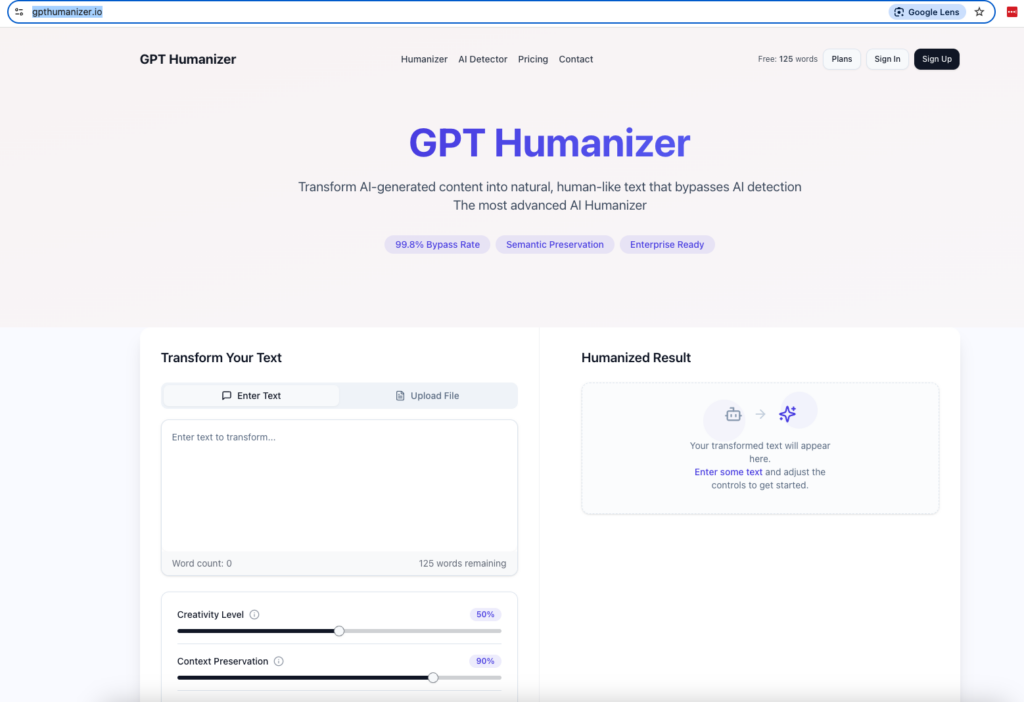
How to use GPThumanizer:
- Paste your AI-generated text
- Select “Academic” mode for essays
- Click “Humanize”
- Review and make minor personal edits
- Run through Turnitin's free checker (if available) before submitting
2. Manual Rewriting Techniques
If you prefer a hands-on approach, these techniques help humanize AI text manually:
Vary your sentence structure:
- Mix short sentences with longer, complex ones
- Start sentences differently (avoid repetitive patterns)
- Use rhetorical questions occasionally
Add personal voice:
- Include first-person perspectives where appropriate
- Reference personal experiences or opinions
- Use colloquialisms and informal transitions
Introduce “imperfections”:
- Not grammatical errors, but natural variations
- Occasional sentence fragments for emphasis
- Varied paragraph lengths
Example transformation:
AI-generated:
“Climate change represents one of the most significant challenges facing humanity today. The increasing global temperatures have led to numerous environmental consequences. Scientists have documented rising sea levels, extreme weather events, and biodiversity loss.”
Humanized:
“Let's be honest—climate change isn't just another environmental buzzword anymore. It's reshaping our world in real-time. I've seen the data on rising temperatures, sure, but what really hit home was watching documentaries about coastal communities already relocating. Rising seas, wild weather swings, species disappearing—it's all connected, and it's accelerating.”
3. Blend AI Content with Original Writing
The safest approach combines AI assistance with genuine original work:
The 60/40 method:
- Write 60% of your content from scratch
- Use AI for 40% (research, outlines, specific sections)
- Heavily edit and personalize the AI portions
Where to use AI safely:
- Research summaries
- Initial outlines
- Data analysis descriptions
- Citation formatting
Where to write yourself:
- Thesis statements
- Personal arguments
- Analysis and interpretation
- Conclusions
4. Use Specific Prompts That Produce Human-Like Text
Not all AI output is equally detectable. Certain prompts generate more natural text:
Better prompts for undetectable content:
Instead of:
“Write an essay about climate change”
Try:
“Write a first-person essay about climate change from the perspective of a college student who recently changed their opinion after researching the topic. Include some uncertainty, personal anecdotes, and informal language. Vary sentence lengths significantly.”
Prompt additions that help:
- “Write with varying sentence lengths”
- “Include rhetorical questions”
- “Add personal opinions and hedging language”
- “Use some informal transitions like ‘honestly' or ‘look'”
- “Make it sound like a real student wrote this, not a professional”
5. The Multi-Tool Approach
For maximum confidence, layer multiple methods:
- Generate content with humanized prompts
- Run through GPThumanizer or similar tool
- Manually edit 20-30% of the content
- Add personal examples and opinions
- Check with a free AI detector before submission
Read more: 10 Best AI Humanizer for 2026 (Compared)
What Doesn't Work (Avoid These)
- ❌ Synonym swapping – Turnitin's algorithm easily detects this
- ❌ Adding random words – Creates grammatical issues, still detectable
- ❌ Translating to another language and back – Produces awkward text
- ❌ Using paraphrasing tools alone – QuillBot-style tools don't bypass AI detection
- ❌ Changing fonts or formatting – Turnitin analyzes text, not presentation
- ❌ Submitting as images – Most institutions require text submissions
How to Check Before Submitting
Never submit blind. Test your content first:
Free AI detectors to check your work:
- GPTZero (free tier available)
- ZeroGPT (free)
- Copyleaks (limited free checks)
- Writer.com AI Detector (free)
Pro tip: If your text passes GPTZero but fails on another detector, it may still fail Turnitin. Test on multiple platforms.
The gold standard:
GPThumanizer includes a built-in detector that specifically tests against Turnitin's algorithm, so you know before you submit.
Frequently Asked Questions
Does Turnitin save my submissions for AI detection training?
Yes, Turnitin adds submissions to its database. This is why the same techniques become less effective over time—the system learns.
Can professors see my AI detection score?
Yes. Turnitin provides instructors with a detailed breakdown, including which sections appear AI-generated and the overall percentage.
Is using an AI humanizer considered cheating?
This depends on your institution's policy. Using AI for brainstorming and then humanizing/editing the output is generally acceptable. Submitting fully AI-generated work as your own typically violates academic integrity policies. Always review your school's specific guidelines.
What's the safest AI percentage to aim for?
Under 15% is generally safe. Under 10% is ideal. Some institutions flag anything above 20%.
Will Turnitin detect if I used ChatGPT for research only?
If you only used ChatGPT for research and wrote the final text yourself, you should be fine. Turnitin detects AI-written text, not AI-assisted research.
The Bottom Line
Turnitin AI detection is sophisticated but not infallible. The most effective approach in 2026 combines:
- Smart AI usage – Use AI as a tool, not a replacement for thinking
- AI humanizer tools – GPThumanizer offers the highest bypass rates for academic content
- Personal editing – Add your voice, experiences, and opinions
- Pre-submission testing – Always check before you submit

Ludjon, who co-founded Codeless, possesses a deep passion for technology and the web. With over a decade of experience in constructing websites and developing widely-used WordPress themes, Ludjon has established himself as an accomplished expert in the field.
Comments