

- 1. Choose a Specific Problem and a Reachable Audience
- 2. Build Evidence Before Making Big Promises
- 3. Turn Your Skills Into an Offer With Clear Boundaries
- 4. Price for the Full Cost of Delivery
- 5. Build a Professional, Useful Online Presence
- 6. Find Your First Clients Through Focused Conversations
- 7. Set Up Onboarding and Measurement Before Launch
- 8. Use AI With an Editorial and Quality-Control Process
- 9. Use Your First 90 Days to Validate the Business
- Start With a Service You Can Deliver Well

Launching a digital marketing agency in 2027 starts with a practical question: what business problem can you solve well enough that someone will pay you to solve it again?
A polished website and a collection of AI tools can support your work, but your first offer needs a clear audience, a defined scope, and a way to measure progress. You can begin as a solo operator and add specialists as demand grows. The challenge is building a service you can sell, deliver consistently, and price sustainably.
This guide turns that process into concrete steps, drawing on agency owners’ Reddit discussions and current platform guidance. Since 2027 is still ahead, the focus is on building a workable business rather than predicting which marketing trend will dominate.
1. Choose a Specific Problem and a Reachable Audience
“Digital marketing for small businesses” leaves a prospect guessing about what you actually do. A more useful starting point is a defined problem: helping local home-service companies turn search traffic into qualified enquiries, or helping online retailers improve their welcome email sequence.
Choose one core service and, if needed, one closely related service. For example, paid search and landing-page improvement belong together because both affect the journey from a click to an enquiry.
Before committing to an audience, speak with several potential buyers. Ask what they have tried, where leads or sales get lost, who approves spending, and what would make outside help worthwhile. Look for a problem they already recognize and have the resources to address.
An industry niche is one option, not a requirement. In an r/agency account of building an agency, the author describes narrowing the service offering while working across industries. They also report substantial prior experience and professional networks—context that makes their path different from a beginner’s. Your starting focus should match both your skills and your access to buyers.
2. Build Evidence Before Making Big Promises
If you have not delivered the service before, begin with a project small enough to supervise closely. This could be your own website, a clearly labeled sample, or a paid pilot for a willing business. A sample demonstrates your thinking; it should never be presented as a client success story.
For real projects, record the starting position, what you changed, the time period, and the result. Explain relevant constraints, such as advertising spend, seasonal demand, or improvements the client made at the same time. Get permission before publishing client names, screenshots, or performance data.
A useful case study answers three questions: what was wrong, what did you do, and what happened? “Rebuilt the enquiry form and checked submissions against the sales team’s records” is more credible than an unsupported claim that you “transformed growth.” Be equally clear when a test did not work.
3. Turn Your Skills Into an Offer With Clear Boundaries
A prospect should be able to understand what they are buying without interpreting a long list of marketing terms. Describe the deliverables, timeline, responsibilities, and limits.
For example, an illustrative landing-page pilot could include:
- An audit of one existing landing page and its enquiry form.
- A revised page structure and copy, with two rounds of revisions.
- Implementation on the existing website, provided the platform supports the agreed changes.
- A check that enquiries are recorded correctly, followed by a review after an agreed observation period.
State what falls outside the fee: a full website rebuild, photography, advertising spend, additional pages, or ongoing campaign management. Specify what the client must provide and how late feedback affects the schedule. A pilot can validate your working relationship and measurement setup; a short project may not produce enough data to prove a performance improvement.
Agree on a written change process. If the client requests another page, explain the additional fee and timing before doing the work. In a Reddit discussion about lessons from agency life, contributors describe unclear boundaries, unpaid extra work, and weak onboarding as sources of strain. Translate those experiences into explicit expectations from the start.

4. Price for the Full Cost of Delivery
A project includes research, meetings, revisions, reporting, and administration as well as production. Estimate all of that time, assign a cost to your own work, and add project-specific software and contractor costs. Track actual hours so your next estimate improves.
Here is a simplified example, not a market-rate recommendation. Suppose delivery requires 20 hours at an internal labor cost of $50 per hour, plus $200 in direct expenses. The estimated delivery cost is $1,200. To leave a 30% margin after those costs:
Fee = $1,200 ÷ (1 − 0.30) = approximately $1,715.
That margin still needs to contribute toward sales time, other agency overhead, and profit; it is not take-home income. Advertising spend and applicable taxes are separate in this example. Your own pricing must also reflect the value of the work and what your target customers will buy.
Use a fixed project fee for defined deliverables and a retainer for a clearly described recurring service. If you offer an introductory discount, give it an end date and a limited scope. Avoid an open-ended commitment at a price that only works when you ignore your own time.
5. Build a Professional, Useful Online Presence
Your first website can be small. It needs to explain who you help, the problem you solve, what your service includes, and how to start a conversation. Add a relevant work sample or case study and an honest description of your experience.
Test the contact form on mobile and confirm that messages reach your inbox. A simple site with a clear next step is enough to support early sales conversations; you can expand it as you learn which questions prospects ask.
Use a dedicated business inbox and consider an address on your own domain. If you are comparing Proton Mail for Business, distinguish its business offering from a free personal mailbox: Proton’s custom-domain setup requires a paid plan and a domain you own. Budget for the features you actually need.
Keep the initial tool stack manageable: email, a place to track prospects, project management, invoicing, and the tools required to deliver your service. Add subscriptions when they solve a demonstrated problem.
6. Find Your First Clients Through Focused Conversations
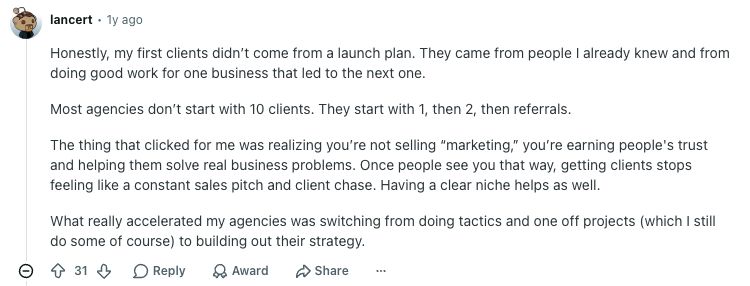
You do not need a large following to start talking to potential buyers. In a Reddit thread about winning an agency’s first clients, several contributors describe beginning with existing contacts and referrals. Others mention direct outreach. These are individual experiences, but they suggest a useful starting point: make it easy for people who know your work to understand whom you can help.
Tell former colleagues, business contacts, and complementary service providers what you now offer. A web developer, for example, may know clients who need help with content after a website launch. Ask for relevant introductions without assuming every contact is a buyer.
For direct outreach, research the business and mention a specific, verifiable issue. An illustrative message might read:
“Hi Maya, I noticed your mobile booking page asks visitors to complete several fields before showing appointment availability. I help service businesses simplify their enquiry process. Would a short outline of two possible improvements be useful?”
Only use an observation you have actually checked. Avoid guessing how much revenue the business is losing. Keep a simple record of conversations, follow-ups, proposals, and outcomes so you can see where prospects lose interest.
On Reddit, use discussions to understand buyers’ language and recurring frustrations. Contribute useful answers where community rules allow it, and respect boundaries around promotion. A thread about a business problem is not an invitation to send unsolicited pitches.
7. Set Up Onboarding and Measurement Before Launch
Before accepting a project, confirm that the client has a workable budget, someone responsible for approvals, and the ability to act on your recommendations. More leads will not solve every problem if the business cannot answer enquiries or fulfill orders.
At kickoff, document the objective, baseline performance, deliverables, payment schedule, communication channel, and review dates. Agree on account access, ownership of work, cancellation, and handover. Arrange business registration, bookkeeping, and appropriate contract support for the jurisdiction where you operate.
Have clients retain ownership of their domains, advertising accounts, and analytics properties, with the agency receiving appropriate access. Use individual accounts and multifactor authentication where available. Establish how access will be removed when the engagement ends.
Then agree on what success means. For lead generation, distinguish an enquiry from a qualified opportunity and a completed sale. Google Ads supports qualified-lead and converted-lead goals, which reflect different stages of that process. Choose measures that fit the client’s actual sales journey.
Test the measurement setup before launching a campaign. In reports, connect activity to outcomes, explain gaps in the data, and identify the next decision. A client should understand what changed and what you plan to do about it.
8. Use AI With an Editorial and Quality-Control Process
AI can assist with outlines, draft variations, organizing approved research, and summarizing notes. Assign a person to check the output before it reaches the client or the public. Verify factual claims and sources, remove generic filler, and add information from the client’s actual expertise.
When reviewing AI SEO content generator options, test them against a real assignment. Consider editing time, collaboration, data handling, and whether the result meets the brief. Fast generation is only useful if it reduces the total effort needed to deliver good work.
For search content, Google’s scaled content abuse policy addresses large amounts of content created primarily to manipulate rankings without helping users, including content made with generative AI. Build your service around useful information and careful review rather than a promise to publish the most pages.
Likewise, avoid promising guaranteed placement in AI answers. Google’s guidance for AI search features says established SEO practices remain relevant and that no special optimization is required for inclusion. Explain what you can improve and measure without claiming control over a platform’s recommendations.
Agree with each client on acceptable AI use and approved tools before entering confidential material into them.
9. Use Your First 90 Days to Validate the Business
Treat this as an adaptable work plan, not a promise that clients will arrive on schedule.
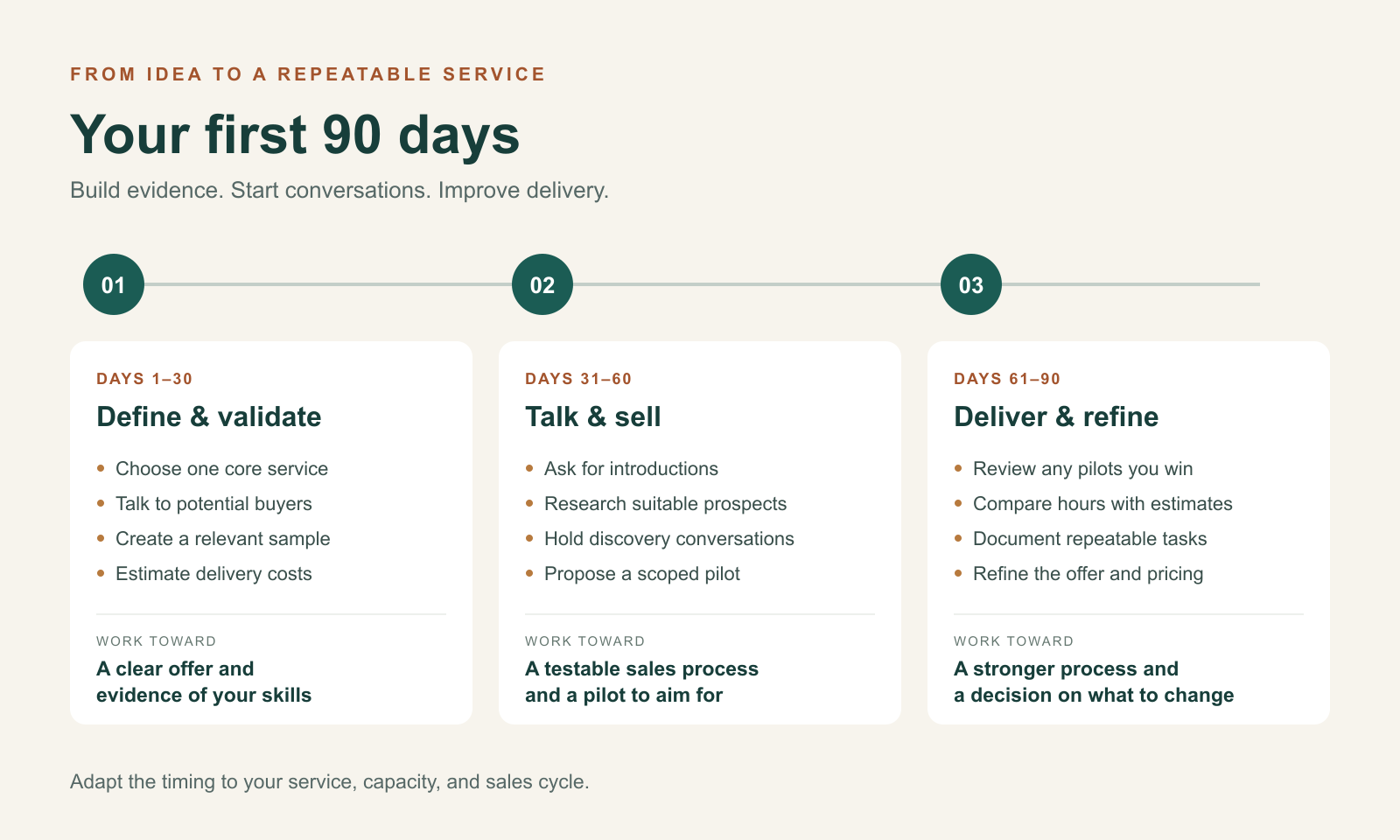
- Days 1–30: Choose a service and audience, talk to potential buyers, build a relevant sample, estimate delivery costs, and publish a simple website.
- Days 31–60: Ask for introductions, start focused outreach, run discovery conversations, and aim to sell a clearly scoped pilot. Record objections and adjust the offer where needed.
- Days 61–90: Deliver and review any pilots you have won. Compare estimated and actual costs, request permission for a case study, and decide whether ongoing work would benefit the client. If you have not won a project, use the conversations to reassess the audience, offer, or evidence.
Document repeatable tasks as you go. Bring in a specialist when you can define the work, fund it, and review its quality. Hire based on sustained demand and delivery needs rather than the appearance of being a larger agency.
Start With a Service You Can Deliver Well
Your first milestone is a client who understands the offer, receives useful work, and pays a fee that supports the effort involved. From there, improve the process, strengthen the evidence, and build a reliable way to find the next client.
As you prepare for 2027, keep checking platform rules and product plans. The durable part of the business is your ability to understand a client’s problem, communicate clearly, and deliver work worth paying for.
Research checked November 10, 2026. Reddit discussions are linked as practitioner anecdotes, not verified earnings data or representative industry benchmarks. Examples and pricing figures are illustrative.

As one of the co-founders of Codeless, I bring to the table expertise in developing WordPress and web applications, as well as a track record of effectively managing hosting and servers. My passion for acquiring knowledge and my enthusiasm for constructing and testing novel technologies drive me to constantly innovate and improve.
Expertise:
Web Development,
Web Design,
Linux System Administration,
SEO
Experience:
15 years of experience in Web Development by developing and designing some of the most popular WordPress Themes like Specular, Tower, and Folie.
Education:
I have a degree in Engineering Physics and MSC in Material Science and Opto Electronics.




Comments