

- Best OpenClaw hosting at a glance
- What OpenClaw hosting needs to provide
- The best OpenClaw hosting providers by use case
- How to compare uptime and speed
- OpenClaw hosting for reliable production
- OpenClaw hosting costs beyond the server
- OpenClaw hosting buyer checklist
- Frequently asked questions
- Conclusion: match the host to the operator
The best OpenClaw hosting keeps your assistant available, preserves its state, and gives someone clear responsibility for updates and recovery. The right choice depends on whether you want a managed application or a server you control yourself. Those are different products, even when both advertise one-click installation.
Cloudways and Hostinger offer managed OpenClaw options. DigitalOcean and Atlantic.Net provide convenient cloud deployment routes with more customer responsibility. Hetzner is an option for administrators who prefer to assemble and maintain their own environment.
This guide compares five providers, explains the costs beyond the server, and includes a production checklist. Prices and documentation were checked on November 17, 2026. We did not run cross-provider speed tests or measure application uptime.
Best OpenClaw hosting at a glance
| Provider | Deployment and management | Price reference | State, backups, and main tradeoff |
|---|---|---|---|
| Cloudways | Managed OpenClaw application | Scout: $9.99/month | Managed backups and restoration; confirm retention and region |
| Hostinger | Managed OpenClaw, APP 1 | $4.99/month equivalent; $119.76 paid for 24 months; renews at $9.99/month for the same term | Managed updates and backups; introductory commitment affects the comparison |
| DigitalOcean | Marketplace one-click Droplet; customer-operated application | From $12/month for the documented Marketplace route | Persistent server storage; arrange backup coverage and updates |
| Atlantic.Net | One-click Cloud Server; customer manages OpenClaw | Selected cloud configuration; verify the current order total | Persistent configuration and sessions; customer owns application operations |
| Hetzner | Self-managed Linux VPS and installation | Live regional configurator; account for IPv4, backups, and tax | Customer plans persistent storage, backup, security, and recovery |
Model usage is a separate budget line. Plans with included credits still have limits; bring-your-own-key plans send model charges to your chosen provider. Browser tools, storage growth, and other integrations may add further costs.
What OpenClaw hosting needs to provide
OpenClaw is an agent application that connects models, tools, and communication channels. Its Linux server documentation describes running it on a server. Hosting keeps the process available when your laptop is offline, but a server alone does not guarantee successful tasks.
Start with persistent storage, sufficient memory, reliable networking, and a supported operating environment. Then decide who handles updates, credentials, backups, and alerts. A convenient installation screen only answers the first deployment question.
Also distinguish an agent using a remote model API from a server running a large model locally. The entry-level plans in this guide are primarily relevant to the former. Local inference has different memory, processor, and possibly GPU requirements.
Managed application versus one-click VPS
A managed application can include platform updates, monitoring, and backup tools. A one-click VPS usually gives you a ready installation on infrastructure that you operate. Self-managed hosting adds the installation work as well.
Before choosing, ask the provider a concrete question: “If an OpenClaw update breaks my agent, who restores service?” Follow that with questions about backup retention, emergency patches, and credential recovery. These answers are more useful than the word “managed” alone.
The best OpenClaw hosting providers by use case
1. Cloudways
Managed operation with monthly pricing
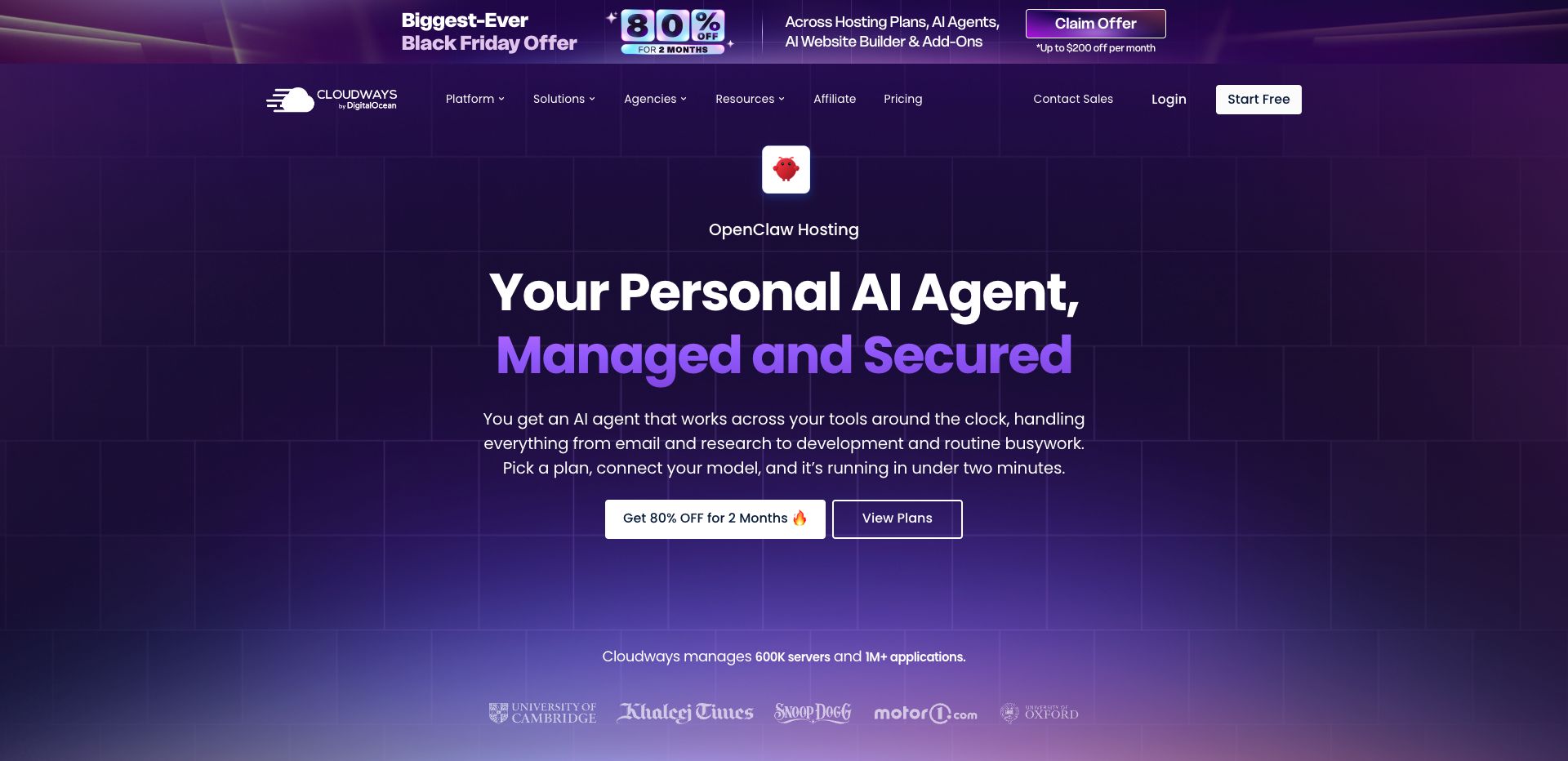
Cloudways’ OpenClaw service includes infrastructure management, security patching, tested application updates, and backup restoration. The Scout plan lists 1 vCPU, 2GB RAM, 50GB storage, and 2TB bandwidth for $9.99 per month. Each plan runs one agent; larger tiers increase resources.
Strengths: A documented application-management scope and a straightforward monthly entry price help buyers who want less server administration. Dashboard access and restoration tools support day-to-day operation.
Limitations: Model API usage is billed separately. More resources do not remove model rate limits or fix a poorly designed workflow. Confirm the available region, backup retention, and support response terms for this specific service.
Best fit: A small business that values managed updates and recovery over unrestricted infrastructure customization. The pricing page should be checked for the final charge and any temporary promotion.
2. Hostinger
A low introductory price for managed OpenClaw
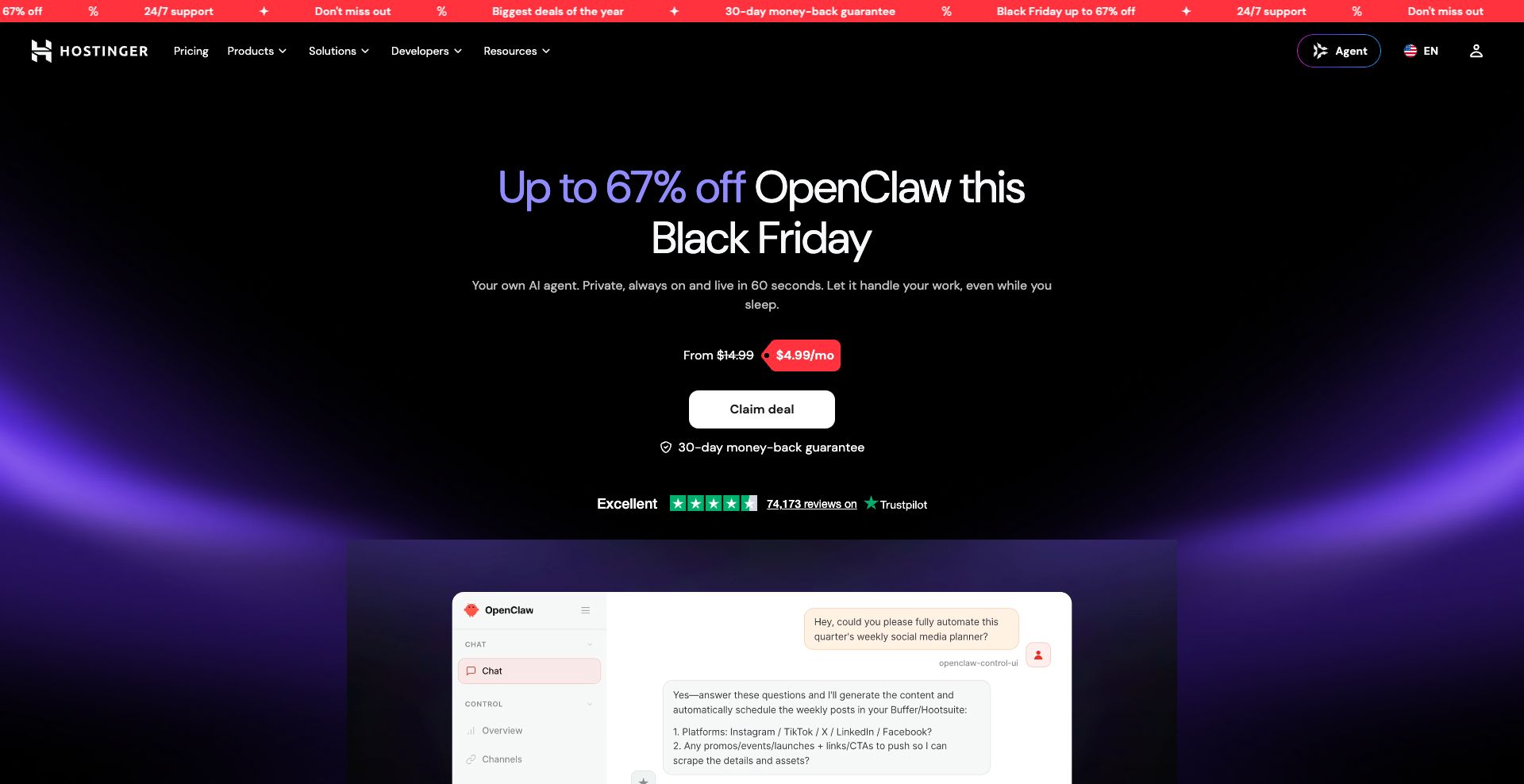
Hostinger’s current APP 1 offer is $4.99 per month equivalent, paid as $119.76 for 24 months. It renews at $9.99 per month for the same term. The advertised resources are 1 vCPU, 4GB RAM, 25GB NVMe storage, and 2TB bandwidth.
Strengths: The managed route includes updates and backups. It can suit a buyer who wants a ready application and accepts an upfront subscription.
Limitations: The introductory monthly figure is not a month-to-month payment. Check model-credit allowances, top-up costs, backup retention, and the region before ordering. Do not confuse this product with Hostinger’s self-managed VPS offering.
Best fit: A beginner who prefers a managed application and has compared the renewal cost. The OpenClaw Hostinger guide distinguishes managed deployment from the VPS route.
3. DigitalOcean
A documented Marketplace deployment
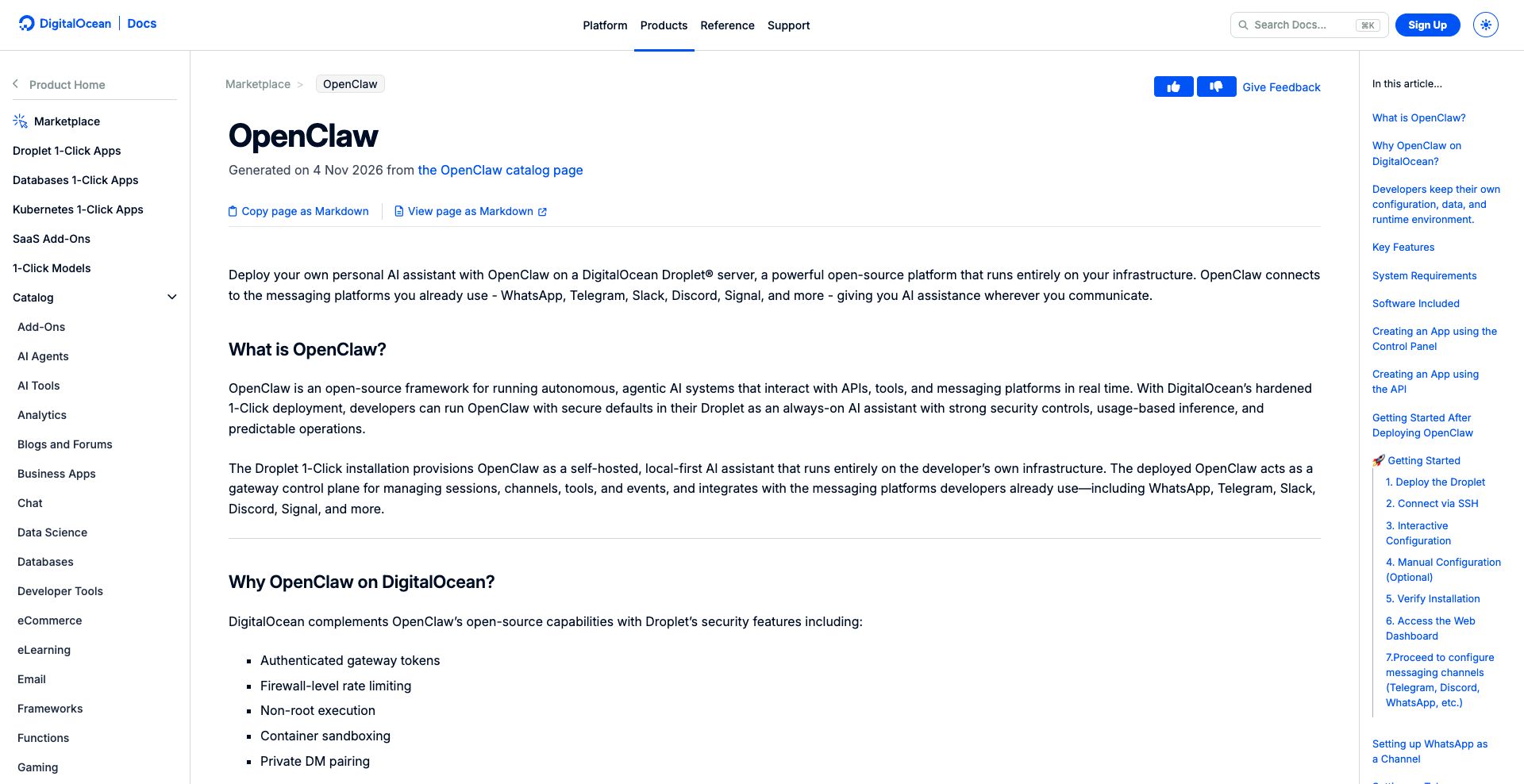
The DigitalOcean Marketplace listing documents an OpenClaw Droplet starting at $12 per month. It provides a prepared deployment on a cloud server, with instructions for setup and maintenance.
Strengths: The route reduces initial installation work while retaining server-level control. Its documentation gives administrators a clear starting point for managing the application.
Limitations: A Marketplace image is not a promise that DigitalOcean will operate your agent. You still need an update process, backup policy, access restrictions, and application monitoring. Budget for any optional backup service and model API usage.
Best fit: A developer who wants a conventional VPS workflow with a supported installation guide. Select a region available for the exact Droplet configuration and review the relevant infrastructure SLA.
The separate manual installation guide describes another deployment path. Its smallest server example should not be substituted for the price or resources of the Marketplace image.
4. Atlantic.Net
One-click deployment with server control
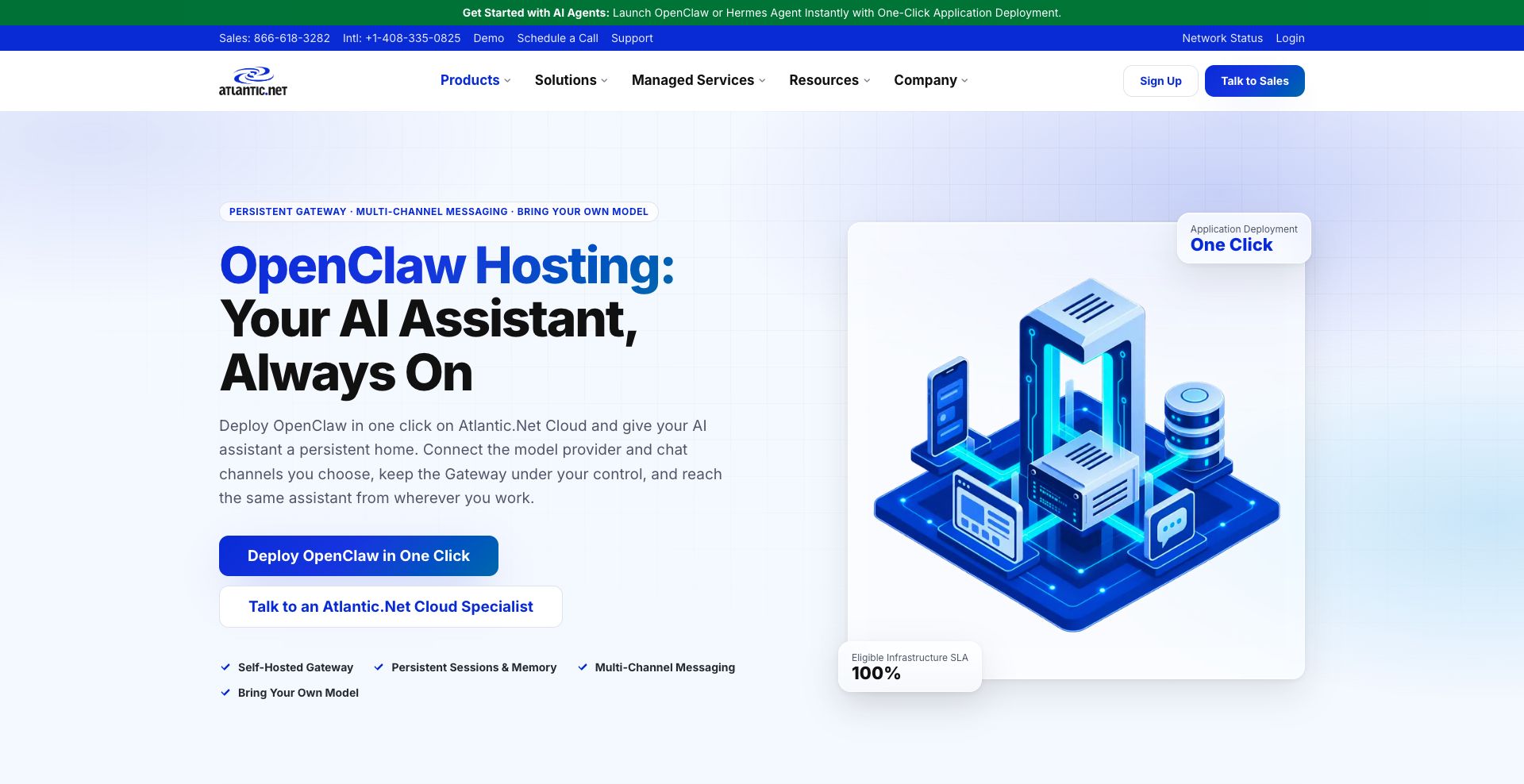
Atlantic.Net’s OpenClaw hosting route deploys the application on a Cloud Server. It describes persistent configuration, sessions, and memory, while customers connect their own model provider.
Strengths: The one-click route reduces installation effort and keeps the application on customer-controlled infrastructure. It can suit a team already using Atlantic.Net’s cloud services.
Limitations: Customers remain responsible for application configuration, credentials, updates, tools, and recovery planning. Infrastructure support and an uptime SLA should not be described as fully managed OpenClaw operation.
Best fit: An administrator who wants a prepared deployment while retaining control. Choose resources and a region in the current cloud pricing configuration, then include backup and model charges. This guide does not apply an unverified promotional price to the OpenClaw workload.
5. Hetzner
Flexibility for experienced administrators
The official Hetzner installation guide describes a self-managed Linux server deployment. It covers persistent state and restricted access. Building from source needs more memory than using a prepared image; the guide specifies at least 6GB for its source-build path.
Strengths: Administrators can choose their operating approach and control the application lifecycle. This suits teams that already maintain Linux infrastructure.
Limitations: Installation, patching, monitoring, backups, and recovery are customer work. Low advertised cloud prices can refer to a different region or processor family than the one you need.
Best fit: A technical buyer who compares the full configuration in Hetzner’s cloud selector. Verify the location, memory, included transfer, primary IP charge, and backup cost. Do not assume that the cheapest European configuration is available at the same price in the US.
How to compare uptime and speed
There is no measured “fastest OpenClaw host” in this guide. An agent’s response time includes several steps: receiving a message, processing local work, calling a model, using tools, and sending a response. Different workflows spend different amounts of time at each step.
A larger server helps when CPU or memory is the bottleneck. It may have little effect when the delay comes from a model API, a slow website, or a rate-limited integration. Therefore, test a representative workflow before paying for a large upgrade.
For availability, distinguish a running virtual machine from a healthy application. A host’s infrastructure SLA may exclude application failures, planned maintenance, or third-party services. Read the relevant terms and confirm what support actually covers.
A practical evaluation plan
- Choose three realistic tasks, including one that uses a browser or external tool.
- Keep the model, prompts, tools, and application version consistent.
- Record completion time, errors, memory use, and model charges.
- Repeat during normal and busy periods.
- Restart the service and verify that required state remains available.
- Restore a backup in a separate test environment before trusting recovery.
This process produces evidence about your workload. It also shows whether a missed task came from hosting capacity, application configuration, or an external service. Record the cause before changing providers.
OpenClaw hosting for reliable production
Persistent state and tested backups
An agent can accumulate configuration, credentials, history, and working files. Make sure these survive container replacement or server restart. Ask a managed provider exactly which state it backs up, how frequently, and for how long.
For a self-managed installation, follow the OpenClaw backup documentation. It warns against copying live database files as though they were ordinary static files. Use a supported consistent backup process, protect the archive, and test restoration.
Keep a recovery copy outside the original machine. Restrict access because backups can contain credentials and private history. Also document what must be reconnected after recovery, including model access and communication channels.
Restricted access and deliberate tool permissions
The OpenClaw security documentation should guide gateway access, authentication, and tool permissions. Avoid exposing an administrative interface directly to the internet without the protections described for your deployment.
Start with only the integrations and permissions the workflow needs. Separate experimental agents from production credentials. Review new tools and skills before enabling them, and keep a way to stop a malfunctioning workflow quickly.
A managed host can maintain the underlying service. It cannot decide which business actions your agent should be allowed to take. That remains an application and organizational decision.
Updates, monitoring, and a named owner
Use the official update guidance for the installation method you choose. Before a major change, create a recoverable backup and define a rollback path. On managed hosting, ask whether updates are automatic and how an incompatible integration is handled.
Monitor both the service and a small representative task. A process can be running while its model key has expired or a channel connection has failed. Send alerts to a person who can act, and document the steps needed to recover.
OpenClaw hosting costs beyond the server
Use this budget: hosting + model usage + paid tools + backups + additional storage or transfer + administration. Compare the same workload and billing period across providers.
For example, a $4.99 introductory monthly equivalent requires an upfront term in Hostinger’s quoted offer. Cloudways’ listed $9.99 Scout price describes a different resource and management package. Neither figure, by itself, tells you the total cost of a busy agent.
Set a model spending limit where available and measure normal usage. Frequent scheduled tasks, repeated failures, long histories, and expensive models can change the bill. Check whether stopping the application also stops the underlying hosting charge; do not assume it does.
Finally, include staff time. A low-cost VPS can be economical for an experienced administrator. For a business without that expertise, a managed service may have the lower practical operating cost.
OpenClaw hosting buyer checklist
- Choose managed application, one-click VPS, or fully self-managed deployment.
- Confirm the available region and the exact infrastructure or application SLA.
- Check memory, persistent storage, and room for temporary browser workloads.
- Name the owner of application updates, secrets, and incident response.
- Confirm backup coverage, retention, offsite copies, and restore procedures.
- Separate hosting fees from model credits, APIs, and paid integrations.
- Record the introductory payment, renewal amount, and cancellation terms.
- Run representative tasks and a recovery test before production use.
Frequently asked questions
Which provider is best for a beginner?
Start by comparing Cloudways’ and Hostinger’s managed OpenClaw products. Their documented management scope reduces server work. Check the current plan limits, payment term, and recovery support before choosing.
Is a one-click installation fully managed?
No. One-click describes deployment. A VPS image can still leave updates, backup configuration, and security with the customer. Ask who handles an application failure after installation.
Which hosting is best for reliable production use?
Choose the service your team can operate consistently. A production setup needs restricted access, persistent state, monitored tasks, and tested recovery. A managed plan helps only when its contract covers the work you need.
Can OpenClaw run on ordinary shared hosting?
Typical website shared hosting is not a suitable default for a persistent agent service with its own runtime and processes. Choose a documented managed application or an appropriate server. Verify the current OpenClaw requirements before ordering.
Should an existing Hermes user choose the same host?
Possibly, if the provider supports both applications with the required resources and management scope. Compare the deployment and recovery details separately. Codeless’s Hermes agent hosting guide offers another starting point.
Conclusion: match the host to the operator
The best OpenClaw hosting depends on who will maintain the agent. Cloudways and Hostinger suit buyers seeking managed application services. DigitalOcean and Atlantic.Net suit teams wanting prepared cloud deployments. Hetzner suits administrators comfortable building and maintaining their own setup.
Use the Codeless hosting research criteria to compare resources, support, and total price. Then validate your own tasks and recovery process. A clear operating plan matters more than an unsupported uptime or speed claim.

As one of the co-founders of Codeless, I bring to the table expertise in developing WordPress and web applications, as well as a track record of effectively managing hosting and servers. My passion for acquiring knowledge and my enthusiasm for constructing and testing novel technologies drive me to constantly innovate and improve.
Expertise:
Web Development,
Web Design,
Linux System Administration,
SEO
Experience:
15 years of experience in Web Development by developing and designing some of the most popular WordPress Themes like Specular, Tower, and Folie.
Education:
I have a degree in Engineering Physics and MSC in Material Science and Opto Electronics.



Comments