


- Best PCI compliant hosting: comparison table
- How Codeless evaluated these providers
- Providers to shortlist for a PCI hosting project
- Conditional options and hosts for outsourced checkout
- What PCI compliant hosting actually covers
- Security features to verify before signing
- Managed versus self-managed PCI hosting
- A short buyer checklist
- Frequently asked questions
- Conclusion: choose evidence and scope before price
The best PCI compliant hosting depends on where your checkout handles card data and which security tasks your team can manage. A host can support a compliant environment without making your entire store compliant. Therefore, the right comparison starts with the exact service, its assessment scope, and your remaining responsibilities.
Atlantic.Net is worth shortlisting for a managed PCI-focused deployment. DreamHost identifies specific eligible services in its compliance policy. Bluehost and InMotion offer routes for teams that can configure and validate a VPS or dedicated server. However, several popular WordPress hosts belong in an outsourced-checkout comparison instead.
This guide audits eight providers from Codeless’s earlier roundup. It separates documented provider claims from evidence a buyer still needs to obtain. Prices and policies were checked on November 17, 2026; availability and terms can change.
Disclosure: This article was prepared as part of sponsored content involving Atlantic.Net. Providers are compared by documented service scope and buyer needs. A commercial relationship does not establish PCI compliance or determine a universal winner.
Best PCI compliant hosting: comparison table
“Supporting” below means the service may help you implement controls. It does not mean that Codeless verified an assessment for your proposed deployment. We did not inspect a current, service-specific Attestation of Compliance (AOC) for these providers.
| Provider and relevant service | Documented position | Management and buyer fit | Price and evidence to request |
|---|---|---|---|
| Atlantic.Net PCI DR Linux | PCI DSS 4.0.1-ready package; obtain scoped AOC | Managed security and recovery bundle | $973.27/month on a 12-month term; confirm renewal and additions |
| DreamHost Managed VPS, DreamPress, Dedicated | Provider identifies these services as compliant; websites excluded | Managed hosting with customer validation | Eligible-plan quote; current AOC and service boundary |
| Bluehost VPS or Dedicated | Customer configuration required; no blanket guarantee | Teams able to own remediation | VPS/dedicated price plus paid compliance assistance where required |
| InMotion VPS or Dedicated | Supports changes based on a customer’s scan | Customer arranges scans; support reviews findings | Eligible-plan quote, scanner costs, management scope |
| SiteGround, confirmed plan only | Case-by-case assistance, not a general attestation | Discuss ASV requirements before ordering | Plan price plus possible dedicated IP and remediation charges |
| Kinsta WordPress hosting | No PCI guarantee or site audits | Conditional option after scope review | Confirm permitted payment design and required adjustments |
| WP Engine | Card-data storage, processing, and transmission prohibited | Use an appropriate third-party payment service | Compare storefront hosting separately from payment compliance |
| Hostinger | Hosting is not a PCI DSS compliant environment | External payment processing only | Not an eligible recommendation for hosting card-data workloads |
These options are not equivalent packages. A low storefront hosting price does not include the same work as a managed payment environment. Get an itemized quote before comparing annual costs.
How Codeless evaluated these providers
This update follows the buyer criteria in the Codeless hosting research methodology: performance, storage, bandwidth, features, support, and pricing. For PCI hosting, we also examined service eligibility, written exclusions, assessment evidence, and responsibility boundaries.
Our research used provider policies and PCI Security Standards Council guidance. We did not run payment workloads, commission scans, inspect private audit reports, or measure uptime. Consequently, provider SLAs are contract promises, not benchmark results. The recommendations below identify suitable starting points for due diligence.
Providers to shortlist for a PCI hosting project
1. Atlantic.Net: managed PCI-focused infrastructure
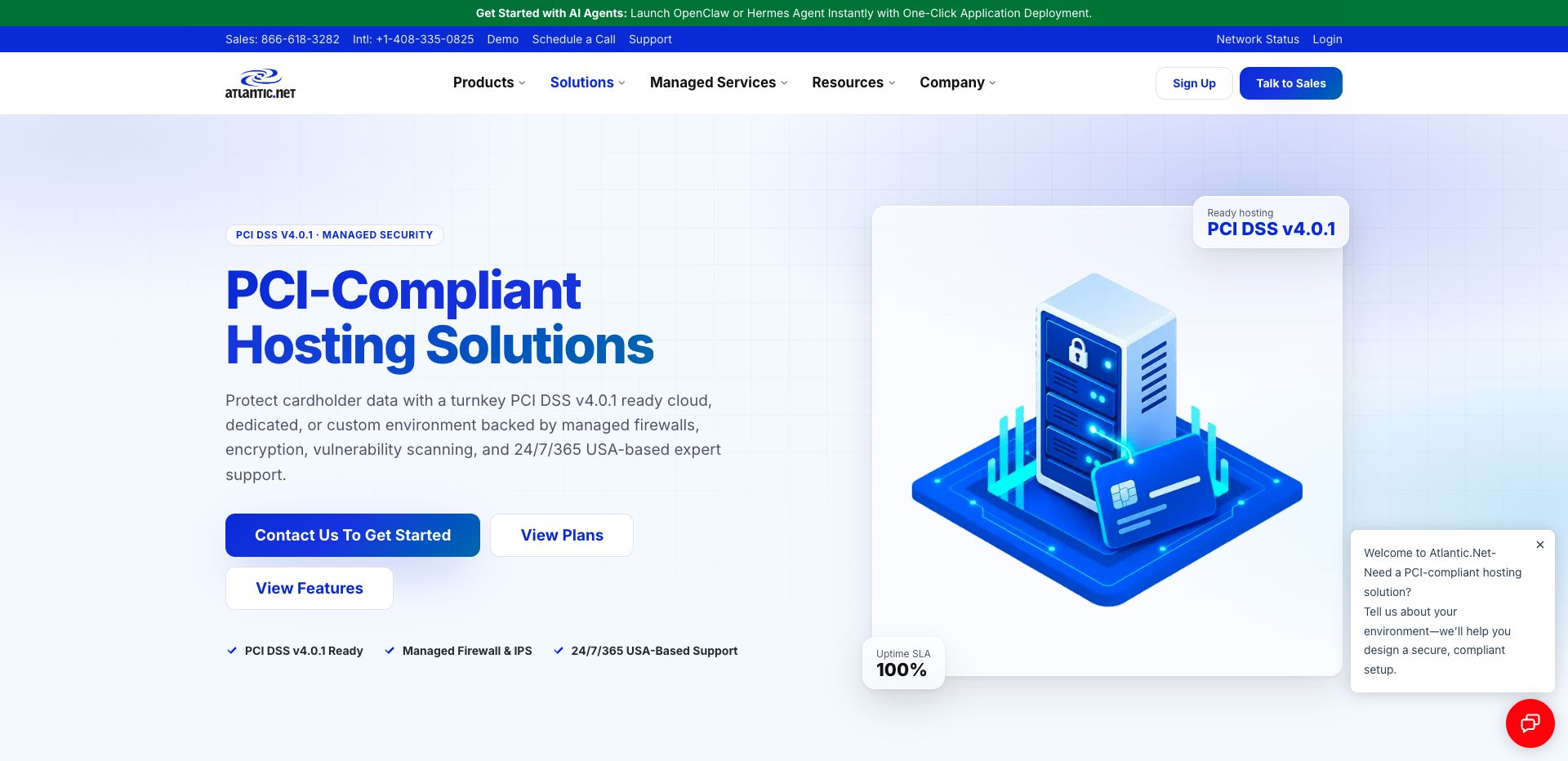
Atlantic.Net’s PCI hosting page lists a PCI DR Linux package at $973.27 per month on a 12-month term. The published configuration includes 6 vCPUs, 16GB RAM, 200GB storage, and 10TB transfer. It bundles a managed firewall, VPN access, backups, vulnerability scanning, and recovery services.
Strengths: The package brings several operational controls into one managed service. Its US-based support operates around the clock. This makes it a practical shortlist option when a business needs help running the infrastructure.
Limitations: The cost and commitment exceed basic VPS hosting. PCI-ready marketing and SOC reports do not replace a current PCI AOC. Application security, payment design, and merchant validation still need named owners.
Before buying: Request the AOC, its assessment date, covered service and location, and a responsibility matrix. Confirm renewal pricing, scan remediation, log retention, and whether WAF or DDoS services cost extra.
2. DreamHost: explicitly identified eligible services
DreamHost’s compliance policy names Managed VPS, DreamPress, and Dedicated hosting as compliant services. It excludes shared hosting and makes clear that its statement does not cover customers’ websites.
Strengths: The policy identifies product families instead of implying that every hosting plan qualifies. It gives existing DreamHost users a concrete starting point for a service review.
Limitations: DreamHost says customers must obtain their own validation and that it cannot assist with that process. A provider-level statement does not establish your application’s scope or controls.
Before buying: Ask for current evidence covering the precise service and confirm whether your payment flow is permitted. Obtain an eligible-plan price, renewal term, backup scope, and support responsibilities. Do not use a shared-hosting promotion as the price for this recommendation.
3. Bluehost: a configurable VPS or dedicated route
Bluehost’s guidance does not guarantee PCI compliance for all accounts. Its VPS and dedicated routes require appropriate customer configuration. Shared hosting is not compliant by default.
Strengths: A configurable server gives a technical team more control over the environment. Bluehost also describes a process for reviewing scan findings.
Limitations: This is not a turnkey compliance service. Assistance can incur administration charges, including a minimum hour for certain requests. A successful scan alone does not validate every applicable requirement.
Before buying: Get a VPS or dedicated quote with security management, backup, and remediation costs itemized. Ask which configuration changes support will perform and which require your administrator. Treat Bluehost as supporting infrastructure until current evidence establishes a narrower assessed scope.
4. InMotion Hosting: support for scan-driven remediation
InMotion’s PCI guidance directs shared-hosting customers toward VPS or dedicated services. It does not provide PCI scans. Customers obtain a scan report and can submit findings to support for review.
Strengths: The documented process can suit businesses with an administrator and an external scanning provider. It provides a clear route for discussing necessary server changes.
Limitations: Scan ownership and the compliance process remain with the customer. Support assistance is not evidence that an entire application has passed an assessment.
Before buying: Confirm the exact eligible configuration, management tier, and response commitments. Include an Approved Scanning Vendor where required, remediation time, and retesting in the budget. Request service-specific assessment evidence rather than relying on the general help article.
Conditional options and hosts for outsourced checkout
SiteGround: confirm requirements before choosing a plan
SiteGround’s guidance describes assistance with requirements such as closing ports for a scan. Some changes may cost extra, and a dedicated IP may be necessary.
Strength: Buyers can discuss specific findings with support. Limitation: This does not establish blanket PCI coverage across its plans. Obtain written approval for your intended architecture, the support scope, and all additional charges. Keep it as a conditional candidate until those questions are resolved.
Kinsta: no blanket compliance guarantee
Kinsta’s technical FAQ says it does not guarantee PCI compliance or perform site audits. It reports that some customers have passed third-party scans after adjustments.
Strength: The policy is clear about its limits. Limitation: Another customer’s scan result does not prove that your checkout qualifies. Confirm your payment architecture and any required changes before purchasing. A SOC 2 report, where available, answers different questions from a PCI assessment.
WP Engine: keep card-data handling off the platform
WP Engine’s policy prohibits storing, processing, or transmitting cardholder data on its platform. It directs customers toward third-party payment services and recommends assessment of the resulting scope.
Strength: The boundary is explicit, which helps buyers design an appropriate storefront. Limitation: WP Engine should not be presented as a host for a card-data environment. Confirm with your assessor that the specific integration respects the policy; a payment plugin alone is not enough evidence.
Hostinger: an ecommerce host, not a PCI environment
Hostinger’s current policy states that its hosting is not intended to provide a PCI DSS compliant environment. It allows ecommerce sites that use external compliant payment processors to handle card data.
Strength: The distinction lets a small merchant consider storefront hosting separately. Limitation: Hostinger should not retain the earlier roundup’s “cheapest PCI hosting” label. Do not route card data through its hosting on the assumption that SSL or a VPS makes the service compliant.
What PCI compliant hosting actually covers
PCI DSS is a payment-data security standard, not a general hosting quality badge. The PCI SSC document library lists PCI DSS v4.0.1. Use the current standard and the validation requirements set by your acquirer or payment brand when planning a deployment.
Think in three layers. First, the provider operates facilities and infrastructure. Second, someone configures the servers, access, logging, and security services. Third, your business controls the application, payment flow, staff access, and operating procedures. A hosting contract may cover parts of the first two layers while leaving much of the third to you.
Ask for an AOC and a responsibility matrix
An Attestation of Compliance summarizes an assessed entity’s compliance status and scope. A Report on Compliance contains more detailed assessment information. Buyers usually start with the provider’s current AOC and supporting responsibility documentation.
PCI SSC guidance on service-provider evidence explains why customers need appropriate evidence from their providers. Check the legal entity, assessment date, services, locations, exclusions, and relevant subcontractors. A logo on a homepage cannot answer those questions.
Then ask who performs each task, who supplies evidence, and who responds when a control fails. The Council’s third-party service-provider guidance helps frame this discussion. Keep the answers in a responsibility matrix attached to the service agreement.
Reduce scope with a deliberate payment design
A hosted checkout can reduce the amount of payment data your infrastructure touches. However, outsourcing payment processing does not erase every merchant responsibility. PCI SSC says merchants must still manage their service-provider relationships and monitor compliance status as applicable. See its outsourced payment processing FAQ.
Map the real journey from the browser to the payment processor. Include scripts, redirects, forms, logs, support tools, and backups. Ask your acquirer or Qualified Security Assessor which validation path fits that exact design. Do this before purchasing a server.
Security features to verify before signing
Segmentation and restricted access
Segmentation can reduce scope when it effectively isolates the cardholder data environment. A separate subnet or a “private network” label does not prove isolation. The PCI SSC segmentation guidance covers modern architectures and scope verification.
Ask for a network diagram and permitted traffic flows. Identify administrators, service accounts, remote access paths, and systems that can affect payment security. Then agree how changes and segmentation tests will be documented.
Encryption, keys, and retained data
Review encryption in transit, protected storage, and key access as separate controls. A TLS certificate protects a connection; it does not establish safe database storage or key management. Your design should also minimize retained data and prevent card details from leaking into logs or support tickets.
Ask who controls keys, how access is restricted, and what happens during backup restoration. Include temporary files and exported reports in the review. Match the final controls to the applicable requirements in the current PCI DSS, rather than treating one encryption checkbox as sufficient.
Monitoring, scanning, and recovery
Request written answers about patch ownership, vulnerability management, alert review, and incident response. Establish which scans and penetration tests apply to your environment, who arranges them, and how findings are closed.
Backups should support a tested recovery process. Agree how much data loss is acceptable and how quickly service must return. Also check whether restoring a backup could reintroduce vulnerable software or obsolete credentials.
Managed versus self-managed PCI hosting
Managed hosting can reduce operational work when the contract includes the controls you need. Yet “managed” has no single scope across these providers. One service may patch the operating system; another may also handle firewall changes, monitoring, and recovery.
Self-managed infrastructure gives an experienced team more control. In return, that team needs time, expertise, and an evidence process. Compare the full cost of both approaches, including administrator hours, security tools, assessment support, and incident coverage.
For a small store using an external checkout, a large managed PCI package may be unnecessary. For an application that handles card data directly, ordinary shared hosting may be unsuitable. The payment design determines the shortlist.
A short buyer checklist
- Document where card data enters, travels, and remains.
- Confirm that the provider permits your exact payment workload.
- Obtain the current AOC and verify its service scope and assessment date.
- Assign every control and evidence task to a named owner.
- Price the eligible service, renewal term, backups, scans, remediation, and support.
- Review access, segmentation, encryption, logging, and incident procedures.
- Test recovery and agree on validation requirements before launch.
Frequently asked questions
Does PCI compliant hosting make an ecommerce site compliant?
No. It can provide part of the required environment. Your application, integration, access controls, procedures, and validation duties still matter. Confirm the complete arrangement with your acquirer or assessor.
Can a payment application run on assessed infrastructure?
Yes, if the service permits the workload and its scope covers the infrastructure you use. However, you still need to identify customer responsibilities. Provider assessment does not automatically include your application code or business processes.
Is SSL enough for PCI DSS?
No. TLS addresses part of data transmission security. PCI DSS also covers other technical and operational requirements. Review the full applicable scope instead of buying a certificate as a compliance shortcut.
Which option is best for a small WooCommerce store?
Start with the checkout architecture. A properly scoped third-party payment flow may let you choose storefront hosting on ordinary business criteria. Compare Codeless’s small-business hosting guide, then verify that the chosen host permits the integration.
Conclusion: choose evidence and scope before price
The best PCI compliant hosting is the service that fits your payment flow and provides clear evidence for the controls it owns. Atlantic.Net offers a managed PCI-focused package. DreamHost identifies eligible services, while Bluehost and InMotion require more customer-led configuration and validation.
For outsourced checkout, compare storefront hosts separately and respect their policies. Before signing, obtain the relevant AOC, written responsibilities, and an itemized quote. That process is more useful than a blanket “PCI compliant” badge or a low shared-hosting price.

Kanika is a Tech Enthusiast who is looking to add meaning to what people read. She is passionate about the emerging technology, gadgets, and web. Kanika has been writing for over 7 years on multiple publications and blogs.





Comments